
The Silicon Review – Cover Page
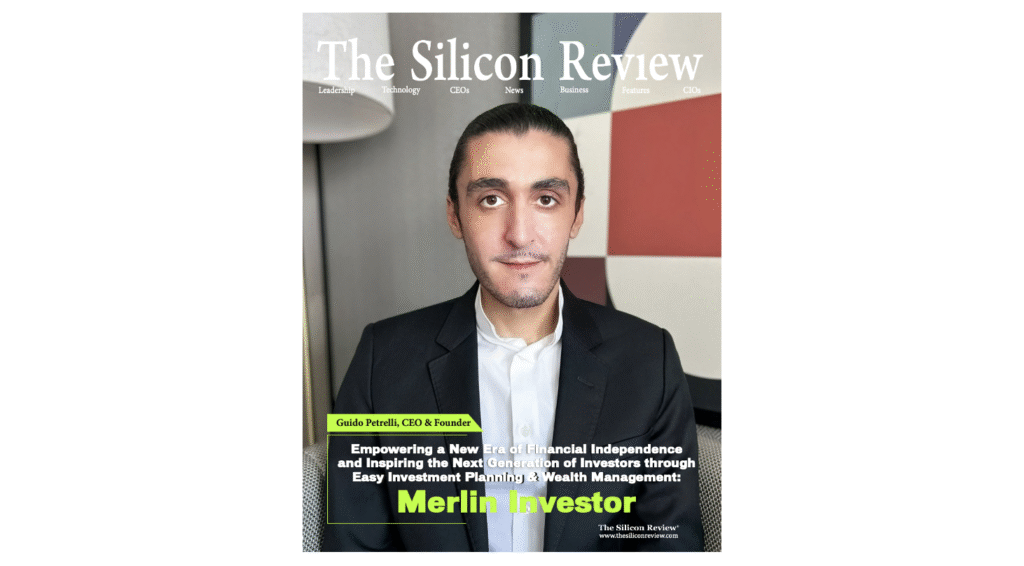
Guido Petrelli, Founder & CEO of Merlin Investor, has been featured as the cover story in the special edition “30 Fabolous Companies of The Year 2024” published by The Silicon Review. Read the full interview as published in Technology Innovators magazine. Empowering a New Era of Financial Independence and Inspiring the Next Generation of Investors through Easy Investment Planning & Wealth Management: Merlin Investor. Through easy and innovative tools designed for the new generations, we aim to create a financially educated society capable of forging and capturing its own financial freedom thanks to conscious investing.” Merlin Investor stands at the forefront of Fintech innovation, pioneering a mission to democratize financial inclusion and investment planning towards conscious investing. Their cutting-edge software is tailored for market insights, investment planning, performance analysis, and portfolio tracking, serving every type of retail investor. The company’s white label solution revolutionizes Financial Institutions’ digital platforms, beckoning the new generation of retail investors by offering a comprehensive investment experience beyond mere trade execution. At the core of their ethos lies the conviction that financial freedom should be accessible to all. Guido Petrelli, CEO of Merlin Investor, spoke exclusively to The Silicon Review about how his company is leveraging individuals with the right tools to shape their investment strategies, enabling them to understand risks seize control of their financial destinies with unparalleled confidence and empowerment. Please tell us about the circumstances or events that led to the founding of Merlin Investor. I was just 16 years old when I opened my first brokerage account. Over time, I decided to rely on financial advisors to handle my investments. However, one day I realized that I was making more money, or losing less, when I invested by myself. I found it frustrating to pay “professional people” to handle my money and not perform as well. I knew that with my academic background in Economics and Finance, developing a diversified and balanced investment strategy was crucial for success. I recognized that the key didn’t just lie in the tools used for trading, but in the execution of a well thought investment strategy. Determined to take control, I decided to stop relying on financial advisors. Despite having the knowledge, I found myself spending a considerable amount of time creating complex spreadsheets to develop strategies, analyze risks, and evaluate performance. This led me to question the existence of a simpler, quicker solution that could be accessible to anyone. To my surprise, when I searched the market, I couldn’t find anything close to what I had in mind. In an era where there is an app for almost everything in life, the absence of a tool for proper market insights, investment planning, and portfolio tracking was apparent. Despite the exponential increase in retail investors thanks to the widespread adoption of trading platforms, I noticed a gap in the availability of a comprehensive tool designed to enhance the trading experience. Believing that many other retail investors faced the same problem, I took it upon myself to build the product I envisioned. Thus, Merlin Investor was born with a mission to democratize financial education and investment planning, aiming to guide individuals toward conscious investing. Setbacks are a part of every growing business. Tell us about a few roadblocks and learning lessons that helped Merlin Investor grow through the years? I believe that starting a company it’s all about getting started because if you knew all the challenges and roadblocks waiting ahead, any rational and sane person would likely give up. Instead, you need to prioritize a clear vision and measurable objectives. Then, you go with the flow and trust your problem-solving instinct as the guiding light to get you through. The reason is simple: you cannot predict in detail all the problems you’ll face, and therefore, you cannot prepare for the solutions in advance. So, it’s better to accept this reality and, every time you encounter a problem, look for a case-by-case solution that shouldn’t compromise the vision and product, as they are the main two pillars upon which to build your success. Challenges differ based on the stage of the company and the context in which you operate, so they’ll be with you along the entire journey, no matter how many problems you’ve already solved. I still remember at the beginning of our journey; it wasn’t easy to design the product just like I envisioned it. The challenge was to transform something like investment planning and risk management, a topic deemed difficult and mastered only by experts, into a sort of game where young investors could easily understand how to analyze and balance their portfolios while enjoying studying the markets through their preferred sources of information and crafting their own investment strategies. We had several internal debates about what was technologically feasible and what product strategy we should have followed by looking at the competitive landscape. As a leader, I learned to let go of non-core technicalities that were probably going to deliver more headaches than benefits. Still I didn’t compromise on those features that, apparently feasible or not, I considered to be differentiating and essential to making the product unique and successful. Of course, I could do so because I knew the high value and experience of our team, and therefore, with the right push, they could realize a product far exceeding my expectations, as much as they did in the end. Another challenge was making our corporate clients see the same trends and future we see for retail investing. In other words, making banks accept a new reality where their clients want to gain a high degree of independence and expect their banks to shift from the role of financial advisor to that of a technology provider. Banks have never been known as first innovators and fast adopters; they tend to minimize risks, thinking that if it worked until now, it’ll still work in the future. Instead, due to the current demographic, geopolitical, and technological transformation, it’s one of the main industries that