
4 Personal Finance books to start with

While all of the information you need is easily available in a blog post or video, the power of reading a good old-fashioned book shouldn’t be forgotten about. Here are some highly recommended resources to help you get started on your personal finance education: “The Total Money Makeover” by Dave Ramsey: This is a great book for beginners.Dave Ramsey is a renowned personal finance expert who offers practical advice for getting out of debt and building wealth. In this book, he presents his seven-step plan to financial freedom, known as the “Baby Steps.” Ramsey focuses on budgeting, eliminating debt, emergency funds, and investing for the future. It’s a straightforward and actionable guide to taking control of your finances and achieving financial peace. “The Intelligent Investor” by Benjamin Graham: Considered a timeless classic, this book by Benjamin Graham is often referred to as the “bible of investing.” Graham, a legendary investor and mentor to Warren Buffett, presents his principles of value investing. He emphasizes the importance of fundamental analysis, buying stocks with a margin of safety, and adopting a long-term investment perspective. This book provides a solid foundation for understanding the principles of sound investing. “Rich Dad Poor Dad” by Robert Kiyosaki: In this classic book, Kiyosaki shares his personal experiences and contrasts the financial mindsets of his own “poor dad” (his biological father) and his “rich dad” (the father of his best friend). He emphasizes the importance of financial literacy, assets versus liabilities, and building wealth through investing in real estate and businesses. This book provides valuable insights on changing your mindset and taking control of your financial future. “The Millionaire Next Door” by Thomas J. Stanley and William D. Danko: This book reveals surprising secrets about America’s wealthy, including the fact that most millionaires live below their means and prioritize financial independence over a high consumption lifestyle. Personal finance is a vast subject, and these books serve as valuable starting points. They can provide you with foundational knowledge and insights to make informed financial decisions. As you continue your financial education, explore additional books and resources to expand your understanding and tailor your learning to your specific goals and interests. Remember, the most important part of financial education is applying what you learn to your own life. Be patient with yourself, and take things one step at a time. Happy reading and learning!
6 Money resolutions to make a Fresh Start this September

As the summer season draws to a close and September approaches, it’s an opportune time to reflect on our financial habits and set new goals for the upcoming months. Making money resolutions can provide a fresh start and help improve our financial well-being. Whether you aim to save more, reduce debt, or develop better spending habits, here are six money resolutions to consider as you embark on a new chapter this September. 1. Create a Realistic Budget One of the most effective ways to take control of your finances is by creating a realistic budget. Start by evaluating your income and expenses, tracking your spending habits, and identifying areas where you can cut back. Allocate funds for essential expenses, savings, and debt repayment. Consider using budgeting apps or spreadsheets to help you stay organized and monitor your progress. A well-planned budget will empower you to make informed financial decisions and achieve your financial goals. 2. Save for an Emergency Fund Building an emergency fund is crucial to protect yourself from unexpected financial setbacks. Aim to save three to six months’ worth of living expenses in a separate account. Set up automatic transfers to ensure consistent contributions. Having an emergency fund provides peace of mind and helps you avoid resorting to high-interest debt in times of crisis. Start with small, regular contributions and gradually increase them over time as your financial situation improves. 3. Pay off Existing Debt Debt can weigh heavily on your financial health, so make it a priority to reduce and eliminate outstanding debts. Start by organizing your debts, prioritizing those with the highest interest rates or smallest balances. Consider implementing the “debt snowball” or “debt avalanche” method, depending on your preference and financial circumstances. Make consistent payments above the minimum amount due to accelerate your progress. As you pay off debts, redirect the freed-up funds towards other debts or savings goals. 4. Invest in Your Future September is an ideal time to evaluate your investment strategy and make adjustments as needed. Educate yourself about different investment options, such as stocks, bonds, mutual funds, or real estate, and consider seeking professional advice if necessary. Set specific investment goals, whether it’s retirement, education, or purchasing a home. Start investing early, even if it’s with small amounts, as the power of compounding can significantly grow your wealth over time. Remember, diversification and a long-term perspective are key to successful investing. 5. Cultivate Mindful Spending Habits Developing mindful spending habits can have a profound impact on your financial well-being. Before making a purchase, ask yourself if it aligns with your goals and values. Differentiate between wants and needs, and practice delayed gratification when possible. Look for opportunities to save money, such as negotiating bills, shopping for discounts, or seeking out cost-effective alternatives. By being intentional with your spending, you can maximize your savings, reduce unnecessary expenses, and make your money work harder for you. 6. Educate Yourself about Money Take the time to educate yourself about personal finance. There are numerous resources available, from personal finance blogs and books to podcasts and online courses. The more you know about managing your money, the better equipped you will be to make informed decisions and achieve your financial goals. Take a look at www.merlininvestor.com and find tips and tools to define your personal financial strategy! Remember, the key to these resolutions is consistency. Progress might be slow, but as long as you are moving forward, you are on the right track. Here’s to a prosperous September and a successful 2024!
Technology Innovators – Cover Page
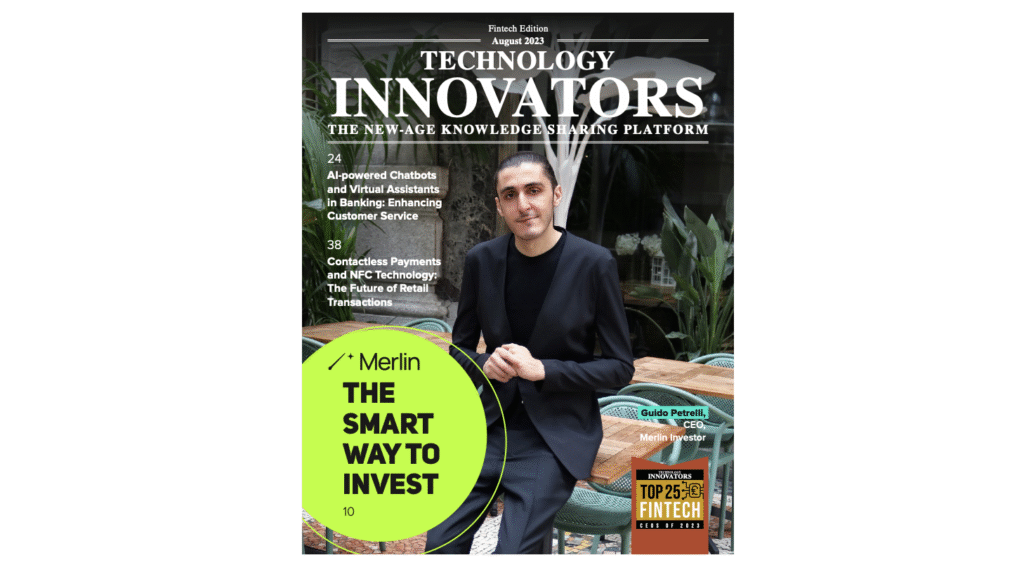
Guido Petrelli, Founder & CEO of Merlin Investor, has been featured as the cover story in the special edition Top 25 Fintech CEOs of 2023, published by Technology Innovators Media Group LLC. Read the full interview as published in Technology Innovators magazine. An experienced corporate executive with demonstrated history and track record in creating and running international companies in several industries and regions, Guido Petrelli is the CEO of Merlin Investor, a fintech company that aims to democratize financial inclusion and investment strategies through a software for market study, investment planning, and portfolio tracking designed for any kind of investor. In an interview, Guido speaks on an array of subjects. Excerpts: Conception of Merlin Investor Says Guido that the world has seen an unprecedented shift in the approach to investing, with the new generation of retail investors being reluctant to entrust third parties for managing their own money while seeking to achieve financial freedom. “Still, we identified the need to educate and empower them with the necessary tools for conscious investing, risk management and strategic planning, as the key elements to become successful and the one and only master of their own financial future.” He adds that trading platforms did a great job in starting a democratization process in the investments space, still they mainly focused on the execution, which alone is not enough and may trigger a gambling approach, especially for beginner investors. “That’s why we saw the need of supporting the new generations to manage the whole investment cycle, while understanding the importance of strategic planning and risk diversification as the key to achieve positive results.” The Merlin solution The Merlin Platform is a multi-asset educational, strategizing and tracking tool, complementary to any trading platform and designed for any kind of retail investor, regardless of the level of knowledge or experience. “Our technology has been developed with the goal to enhance conscious investing for everyone and to empower the new generations to easily understand and manage the full investment cycle all in one place, while also taking into consideration the role that social media plays today when it comes to investing.” To complete the trading experience already offered by banks and trading platforms, the technology has been designed as a white label solution that financial institutions can easily integrate into their own digital platforms to offer an innovative, complete, and comprehensive digital investing experience to their clients. Merlin Investor—the conscious way of investing Maintains Guido that only through strategic planning is it possible to balance and diversify risks while building long term positive results. “To buy and sell assets without a plan would only set you up for potential catastrophic losses. It’s the norm for all professional investors, and it shall be the same also for the new generation of retail investors considering they are playing the same game.” Guido explains how the company found out most young folks who trade are investing without a strategy mindset. It’s a very risky approach for them, and therefore for the society, because historically markets have ups and downs, and only thanks to a positive sum game based on risk management is possible to build long lasting wealth and reach a real financial independence. “The analogy I can see is that the spread in the use of retail trading platforms has given anyone a Ferrari to drive, a very powerful but risky solution, but before doing that we missed to educate and equip them with the basic tools for conscious driving.” The result is that when the weather is nice, and there are no bumps or holes in the road, meaning when we are in a bull market, everybody believes to be the best driver in the world. Then when the conditions change the probability to crash becomes huge.” Based on this analogy, the company is on a mission; its moots for conscious investing and strategic planning, that is made accessible to all, regardless the level of knowledge or experience. “Through our product, we gamified the full investment cycle by making market study, investment planning, and performance tracking, understandable and fun for the new generation of retail investors, with the ultimate goal to help and empower them to become the one and only master of their own financial future. Then by embedding our white label technology into their own digital platform financial institutions can go beyond the sole execution of trades while offering a full and professional investment experience to anyone and all in one place.” Creating perfect synergies between fintech companies and financial Institutions “I believe fintech companies have a great spirit of innovation which is not biased and affected by old best practices or past consumer behaviours. This is combined with high flexibility, speed, and risk attitude. At the same times banks have a strong understanding in terms of compliance, which is very important to make a new technology deployable into the market, together with deep market reach and a huge and loyal consumer base acquired through the years, which makes possible to effectively deploy a new technology to a wide audience in a very short period.” Guido adds that combining the expertise of fintech companies and financial institutions, to exploit synergies and to create the perfect mix for a huge market success of new financial technologies should be the new approach. “Our approach is to work very close to the banking system in a proactive and constructive way, so that each party can learn from the other and add value in identifying the best formula for the best product market fit towards mutual success. That’s why I personally see a very collaborative and synergic approach between Fintech companies and Financial Institutions as the key for proper innovation in the banking system in the interest of both sides, and more important in the interest of the customer base who is ultimately served.” Innovation—The key Guido believes that the success for fintech startups comes from their strong ability to innovate and quickly deploy cutting-edge and cost-competitive technologies into the
Understanding ETFs and Their Potential vs. Stocks and Bonds

In the wide realm of financial investment options, three major players dominate the scene: stocks, bonds, and exchange-traded funds (ETFs). Each has unique characteristics that can make it more or less appealing depending on an investor’s objectives, risk tolerance, and time horizon. What are Stocks, Bonds, and ETFs? Before comparing them, let’s briefly define what these investment vehicles are. Stocks represent ownership shares in a company. When you buy stock, you’re purchasing a piece of that company, often referred to as equity. The value of your stock varies based on the company’s performance and market perception. Bonds are essentially loans you make to a corporation or government entity, which agrees to pay you back with interest after a certain period. Bond value is tied to the financial health of the issuer and interest rates. Exchange-Traded Funds (ETFs) are investment funds traded on stock exchanges. An ETF holds assets such as stocks, bonds, or commodities. Most ETFs are passively managed and aim to track the performance of a specific index. ETFs vs. Stocks When you invest in an individual stock, your return is dependent on the performance of a single company. This approach can offer high rewards if your chosen company does well, but it also comes with significant risk. If the company performs poorly, your investment can lose value. On the other hand, ETFs offer a way to invest in a diversified portfolio of assets. A single ETF can hold dozens, hundreds, or even thousands of different stocks or bonds. This diversification reduces the risk associated with the performance of a single company. Even if one stock within the ETF performs poorly, others may do well, balancing out potential losses. However, while diversification mitigates risk, it also limits the potential for high returns. With an ETF, you’re unlikely to see the dramatic gains that can come from investing in a high-performing individual stock. ETFs vs. Bonds Bonds are traditionally considered less risky than stocks. They offer fixed interest payments and return the principal amount at maturity. However, bonds are sensitive to interest rate changes. When interest rates rise, bond prices fall, and vice versa. ETFs can provide exposure to the bond market while offering more liquidity and flexibility. Bond ETFs hold a portfolio of different bonds, allowing investors to benefit from the stability of bonds while also spreading their risk across various issuers or types of bonds. However, bond ETFs do introduce some additional risk compared to individual bonds. Bond ETFs don’t have a maturity date, meaning investors are more exposed to interest rate risk. Furthermore, the value of a bond ETF can fluctuate throughout the trading day, whereas individual bonds are less volatile. The Potential of ETFs A major advantage of ETFs is their flexibility. They allow investors to gain exposure to a wide range of asset classes, sectors, or investing strategies. For example, there are ETFs that focus on technology stocks, green energy companies, high-yield bonds, emerging markets, and many more. ETFs also offer intra-day liquidity. Unlike mutual funds, which can only be bought or sold at the end of the trading day, ETFs can be traded throughout the day just like individual stocks. This allows for more active trading strategies and better control over the price you pay or receive for the ETF. Conclusion No single investment is the best choice for everyone. Individual stocks can be an excellent choice for those who have specific knowledge about a company or industry and are willing to take on more risk for the potential of higher return. Bonds tend to be a safer investment, offering steady income with less volatility. ETFs, with their inherent diversification and flexibility, can be a valuable addition to a balanced portfolio. They offer exposure to a variety of asset classes and strategies, reducing the risk of being tied to the performance of a single company or bond issuer. Remember, investment decisions should always be made in the context of your financial goals, risk tolerance, and investment horizon. Consider consulting with a financial advisor to help guide your investment choices.
Finovate Blog – Written Interview
Guido Petrelli, Founder & CEO of Merlin Investor, sat down with David Penn from Finovate to discuss the evolving retail investment landscape and how Merlin Investor is working to democratize access to investment strategies for a new generation of investors.Here is the full interview as published on the Finovate website. Meet Merlin Investor: Democratizing Access to Investment Strategies for a New Generation Launched in the fall of 2021, Merlin Investor is on a mission democratize access to investment strategies. The fintech offers a while label, multi-asset, educational, strategizing and tracking tool that helps investors accomplish two critical goals: building long-term positive results and limiting potentially catastrophic losses. Merlin Investor’s technology is compatible with all trading platforms. The technology is suitable for both retail and professional traders, and is available for both the desktop and mobile. Merlin Investor enables users to retrieve market data and sentiment from multiple sources and apply that data to a massive range of tailor-made investment strategies. With offices in both West Palm Beach, Florida, and Lugano, Switzerland, Merlin Investor made its Finovate debut at FinovateEurope earlier this year. The company returned to the Finovate stage in May for FinovateSpring. We caught up with Merlin Investor founder and CEO Guido Petrelli (pictured) this summer to learn more about the company, its mission to democratize access to investment strategies, and what to expect from the company in 2023 and beyond. What problem does Merlin Investor solve and who does it solve it for? Guido Petrelli: Merlin Investor was born as an intelligent protection and conscious guide for a more farsighted management of investments aimed limiting potential catastrophic losses while building long term positive results. Thanks to the Merlin platform, retail investors can educate themselves, study the markets, and create and track their own investment strategies to easily understand, balance and diversify investment risks. In other words, we help and empower a new generation to invest with strategy in mind. This is the key to becoming successful and is the only factor distinguishing between gambling and investing. As we are on a mission to democratize financial inclusion and investment planning, our technology was built to allow anyone, regardless the level of knowledge or experience, to become independent and the one and only master of their own financial future. How does Merlin Investor solve this problem better than other companies? Petrelli: In the retail investor space, we see many companies focusing on execution, meaning focusing on the act of buying and selling assets. But executing without evaluating multiple sources of information first, combined with the lack of a diversified and balanced investment strategy, can lead to uncontrolled and unlimited potential losses because of the market’s ups and downs. While it may imply the chance for quick gains, it’s actually not the norm as wealth is usually built over time by managing a positive-sum game. That’s why from the very beginning Merlin was designed as a complementary product to a trading platform and not as a substitute solution. Merlin Investor addresses the strategic essence of investing while the majority of the competition just focuses on enhancing the trading experience – which is already well supported by several financial institutions in a pretty similar way. Who are Merlin Investor’s primary customers. How do you reach them? Petrelli: Our primary customers are financial institutions focusing on educating a new generation of retail investors and offering the possibility to trade different asset classes through their digital banking platforms. We attend multiple fintech events in several countries that are attended by financial institution decision-makers responsible for delivering an innovative and digitalized experience to their clients. We also analyze the markets to identify those prospect clients we believe to be a fit in terms of services and client base. Then we look for the people focusing on retail digital products and platforms and reach out to them to introduce our company and technology. Last, we work to be featured in fintech-specialized magazines having financial institutions as target audience. Can you tell us about a favorite implementation or deployment of your technology? Petrelli: We offer our technology as a white-label solution that financial institutions can easily embed into their own digital platforms through API keys, while having the possibility to customize product’s appearance and features. As result, our product is delivered to the final users in the bank’s name and as a sub-section of the same app/e-banking they are already familiar with. Through our B2B partner’s portal, we grant to financial institutions the flexibility to choose from the full Merlin product those asset classes, sections, features, and contents they intend to integrate based on their own specific needs. In this way, they can design a tailored solution and experience for their own clients, while sticking to the overall structure and design of the banking platform they already offer. What in your background gave you the confidence to respond to this challenge? Petrelli: In a nutshell, it was the combination of my knowledge around investing and the problem I personally experienced as a retail investor that led to Merlin Investor. In fact, I was just a teenager when I first started to trade. Then I quickly realized that executing trades “per-se” – meaning the simple action of buying and selling assets – is the less strategic and relevant part to achieve long term positive results. Instead, studying different market sources, and then designing a diversified and balanced investment strategy, are what make the difference in the end. Still, (available) banking and trading platforms were not enough to educate me about investing, or to (help me) design and analyze my own investment strategies. As a result, for years I was forced to create time-consuming and unfriendly spreadsheets to the point where I couldn’t accept it anymore – not in a world like today’s where we have an app for everything we do! At the same time with trading platforms booming basically everywhere, it became more and more clear that a new generation wants to invest autonomously and in
How Much Money Do You Really Need for Retirement?

Retirement planning is one of the most critical exercises in personal finance. How much money you need to retire comfortably is a question that doesn’t have a one-size-fits-all answer. It depends on numerous factors, including lifestyle choices, the timeline for retirement, life events, inflation, stock market returns, and saving rate. U.S. vs European Lifestyle The lifestyle you envision for your retirement significantly impacts how much money you’ll need. For instance, living costs can differ dramatically between the U.S. and European countries. In the U.S., retirees often face higher healthcare costs, which can significantly inflate their retirement budget. On the other hand, many European countries have universal healthcare systems, which can reduce out-of-pocket healthcare costs for retirees. However, taxes can be higher in many European countries, which might reduce net income from retirement savings. In contrast, U.S. retirees might benefit from certain tax advantages on retirement income. Moreover, lifestyle choices like travel, hobbies, and entertainment can also impact retirement savings needs. For instance, if you dream of a retirement filled with globetrotting, you’ll need to save more than someone planning a quiet retirement in a low-cost area. Retirement Timelines: 10, 20, 30, and 40 Years The timeline for your retirement is another key factor. If you plan to retire in 10 years, you’ll need to save more aggressively than if you have 40 years until retirement. Assuming a retirement age of 65, here are some general guidelines: Variables Affecting Retirement Savings Life Events: Events like marriage, children, illness, or unemployment can significantly impact your ability to save for retirement. Inflation: Inflation reduces your purchasing power over time. A retirement plan should consider the impact of inflation to ensure that your savings maintain their value in real terms. Stock Market Returns: Your retirement savings growth largely depends on your investment returns. While the stock market has historically provided positive returns over the long term, it’s essential to account for periods of lower returns or market downturns. Saving Rate: The percentage of income you save directly impacts your retirement savings. A higher saving rate can help build a more substantial nest egg. Determining how much money you need for retirement involves considering multiple factors and making some personal assumptions. Regardless of where you live, or when you plan to retire, start saving and investing as early as possible. Regularly review and adjust your plan to account for life changes, economic conditions, and financial market performance. Make sure to create a plan that fits your individual needs and goals.
How important is AI in Finance?

Artificial Intelligence (AI) has a wide range of applications in finance. Some of the most common areas where AI is used in finance include: 1. Fraud Detection: AI algorithms can analyze large amounts of data and identify patterns that may indicate fraudulent activity. 2. Risk Management: AI can help financial institutions identify and manage risks by analyzing historical data and predicting future trends. 3. Investment Management: AI can analyze market data and make predictions about the performance of investments, helping investors make more informed decisions. 4. Customer Service: AI-powered chatbots can provide customers with personalized support and assistance, improving customer satisfaction and reducing wait times. 5. Trading: AI algorithms can analyze market data in real-time and execute trades based on specific parameters, helping traders make more profitable trades. 6. Credit Scoring: AI can analyze a wide range of data to assess creditworthiness and determine the likelihood that borrowers will default on their loans. 7. Portfolio Optimization: AI algorithms can analyze data on various assets and their risk-return characteristics to optimize portfolios for investors. This can help investors achieve their desired level of risk and return. 8. Trading Strategy Development: AI can help traders develop and test new trading strategies by analyzing historical market data and identifying patterns that can be used to make profitable trades. 9. Fraud Prevention: AI can analyze large amounts of data in real-time to detect anomalies that may indicate fraudulent activity. This can help financial institutions prevent losses due to fraud. 10. Regulatory Compliance: AI can help financial institutions comply with complex regulations by analyzing data and identifying potential compliance issues. 11. Chatbots and Virtual Assistants: AI-powered chatbots and virtual assistants can provide personalized customer support and assistance, reducing the workload for human customer service representatives and improving customer satisfaction. 12. Credit Risk Assessment: AI can analyze a wide range of data, including credit histories, income, and employment information, to assess creditworthiness and determine the likelihood that borrowers will repay their loans. 13. Predictive Analytics: AI can analyze historical data and make predictions about future trends, helping financial institutions make informed decisions about investments, risk management, and other areas. Overall, AI has the potential to revolutionize the financial industry, however, it is important to ensure that AI is used responsibly and ethically, as it can also pose risks related to bias and privacy. Overall, AI is transforming the financial industry by enabling faster, more accurate decision-making, improving risk management, increasing efficiency, and enhancing customer experience.
Finovate Spring 2023
Merlin Investor showcased its cutting-edge retail investment platform at Finovate Spring 2023 in San Francisco, engaging a wide array of North American financial organizations in attendance. During the live demonstration, the company illustrated how financial institutions can strengthen their digital platforms by guiding and equipping retail investors with knowledge. The session emphasized that fostering informed investment decisions leads to greater user involvement, along with a rise in deposits and trading commissions. Merlin Investor’s showcase attracted considerable interest, prompting many attendees to visit the booth afterward to gain deeper insights into the technology and discuss possible applications. Watch the full demo video here: https://finovate.com/videos/finovatespring-2023-merlin-investor/
Fintech Finance News – Video Interview

During Finovate Europe 2023 in London, Merlin Investor’s Founder & CEO, Guido Petrelli, sat down with a reporter from Fintech Finance News to discuss the company’s origins, mission, and future plans. Below is the abstract from the FF News website. The full video interview is available here: https://ffnews.com/fintech-tv/merlin-investor-guido-petrelli-finovate-europe-2023/ At Finovate Europe 2023 in London, we had a conversation with Guido Petrelli, the founder and CEO of Merlin Investor. Merlin Investor is a fintech company on a mission to democratize system investment strategies and offer software for strategic investment planning and management to retail investors. “The Merlin platform is an educational strategizing and tracking tool that can be used with any kind of asset. It’s complementary to any trading platform and designed for any kind of retail investors. Basically, what we have seen is a new generation of young investors that start to buy and sell assets through the several trading platforms that are now available, but they did that without developing a plan before. So, without the concept of diversifying the risks that you take when invested.” “So, Merlin Investor was seen as a guide in the process of being educated and becoming more expert in order to be autonomous in trading but doing that with a strategic approach and with an experimentality.”
Finovate Europe 2023

Merlin Investor took the stage at Finovate Europe 2023 in London to present its retail investment platform to an audience of banks and financial institutions from across Europe. During the live demo, the company showcased how financial institutions can enhance their digital offerings by educating and empowering retail investors. The presentation highlighted how supporting conscious investing can drive higher user engagement and increase both deposit levels and trading commissions. Merlin Investor’s demo drew significant attention, with numerous attendees visiting its booth afterward to learn more about the technology and explore potential use cases. Watch the full demo video here: https://finovate.com/videos/finovateeurope-2023-merlin-investor/